This week felt like my body and my life were operating on two completely different schedules.
My body wanted heating pads, pain patches, hot baths, a recliner, and for everybody to leave me the hell alone.
My life said:
Cool. Anyway, you’re going back to work. The kids miss you. Your sister needs help. There are dinosaurs to watch. Somebody is going to walk UP a slide. And apparently you’re going to end the week at a spontaneous photoshoot.
😅
I started the week on my period, which is exhausting enough on its own, but now that I know I have both a fibroid and endometriosis, I’ve been doing what any curious person with access to Google does:
Looking up all the weird shit my body does and going,
Ohhhhh. So THAT’S why.
😂
The lower back pain.
The constant urge to pee.
The horrible cramping when I poop.
The extra bleeding when I do.
Apparently, my body has explanations for things I’ve just been suffering through for years.
And listen—
period poops are already the WORST.
I do not need two separate medical conditions working together to make them worse. 😮💨
Sunday was actually surprisingly good for day two of my period. I barely hurt all day, and I had even slept through the entire night before—which is WILD for me because I’m normally up and down for the first two or three nights because I’m hurting so badly.
Then I pooped.
And apparently that was enough to ruin everybody’s good time.
😂
By 4:30 Monday morning, I was hurting badly enough that I ended up taking an hour-long nap on the toilet so I could free bleed.
Obviously.
Nobody ever talks about how much passing period clots can fucking hurt, either.
This period was super clotty, and whether that had anything to do with recently having surgery or not, I have no idea.
I just know:
boy, I was in pain.
I finally fell back asleep around 7 and slept until 11:30.
Thankfully, my sister had asked Mom to watch the kids that day because I really just could not.
I remembered that the hysterectomy belt my boyfriend’s mom gave me had heating/cooling pads in it, popped those bad boys in the microwave for thirty seconds on each side, and discovered that I basically own a portable heating pad.
Guess who’s taking that bitch to work?
🤷🏻♀️😂
Tuesday morning?
4 AM.
Again.
More pain.
More soaking in the bathtub.
And eventually a PTO day because there was absolutely no way I was going back to work like that.
At one point, I was so over the pain that I genuinely thought about asking my boyfriend if he would be okay with adopting because I just—
cannot keep doing this.
I’m ready for them to get this stuff taken care of.
My periods are exhausting.
Physically.
Emotionally.
All of it.
But somewhere between all the heating pads, pain patches, baths, and me refusing to leave the recliner unless absolutely necessary…
the rest of my life kept happening anyway.
And somehow, by the end of the week, there was a whole lot of good mixed in with the hurting.
☕ This Week’s Comfort
This one is easy.
My heating pad.
😮💨
That thing and I have been in a committed relationship all week.
Monday, it was the heating pads from the hysterectomy belt.
Tuesday, I basically lived in the recliner with my heating pad and only got up when I absolutely needed to.
And then Doodoo showed up.
He was asleep when Mom brought him over, and when he came inside, he looked at me, climbed into my lap, and immediately went right back to sleep.
I sat him on my stomach.
And somehow?
His weight actually helped.
So I leaned the recliner back with this sleeping baby sprawled across me and got maybe thirty or forty-five minutes where I wasn’t hurting much at all.
I was almost asleep myself before the other two came inside.
😂
Apparently Doodoo is also a heating pad.
A significantly heavier one.
With legs.
And opinions.
But I’ll take what I can get.
📷 Through My Lens
I think my favorite part of this week happened today.
I took Doodoo home early, came back, cleaned the living room, got myself ready, and headed to my friend’s house.
And then we just drove around and took pictures.
No real plan.
Just a spontaneous photoshoot.
She took me to 420 Road, which is apparently basically a mile of road where people go to spray paint.
I had never been there before today.
Then we went to take pictures with planes coming in.
😂
And it was actually really fucking fun.
After spending the beginning of the week barely wanting to leave my recliner, ending it out driving around, finding weird places, and taking pictures felt good.
I love photography.
I love finding interesting things to photograph.
And apparently I also love standing around waiting for airplanes to fly over me.
Who knew?
😂
💭 A Thought I’ve Been Carrying
I don’t think you always realize how much you’re part of somebody else’s routine until you disappear from it for a while.
Wednesday was finally my first day back at work.
And all morning I heard:
“Welcome back.”
“Where have you been?”
“I thought you weren’t working here anymore.”
“Are you okay now?”
“What happened?”
“You’ve been missed.”
I didn’t tell everybody where I was going before I left.
Honestly, I only really talk to maybe five people there anyway. The people who mattered knew I had surgery and knew I was going to be gone for a month.
I wasn’t about to make some giant announcement or walk around campus telling everybody individually.
😂
But apparently people noticed.
And then I got on my kiddo’s bus.
He stood up.
Looked at me.
Looked at the bus monitor.
Looked back at me.
And just—
smiled.
This huge smile.
🤣
He genuinely looked flabbergasted for a second.
Like his brain needed a minute to process:
Wait.
She’s back?!
Then he finally remembered he was supposed to grab his bag and get off the bus.
He spent the rest of the day running back over to me for hugs and back scratches.
Although I’m pretty sure he missed my nails more than he actually missed me.
😂
And apparently he wasn’t the only one.
Wednesday evening, Sissy and Doodoo called wanting apples.
So obviously I grabbed my last three apples, a Fudge Round, and a Nutty Bar and went over there.
We played.
Had a little dance party.
Snuggled.
And at one point I had a kid on each hip while another one tried climbing up my leg, slipped on my pajama pants, and pulled my pants down with him.
☠️🤣
My sister had to pull them back up for me.
When I left, Pooh Boy threw a tantrum because he wanted to stay the night.
Then Thursday morning my sister told me he’d been up crying because he wanted to stay with me.
😭
And Thursday night, after Doodoo and Pooh Boy spent the evening at my house, Mom took them home.
I was still on the phone with my sister when they pulled up, and Doodoo was crying.
He had been perfectly fine when he left my house, so I asked what happened.
My sister opened his door.
And there he was, crying:
“Blah Blah!”
🥲
Baby.
I told him I had to work the next day, but I could come get him afterward and he could stay with me all weekend.
He stopped crying and said okay.
My babies.
😭
It breaks my whole soul when they cry because they want to stay with me and I can’t keep them.
But between them and my kiddo at work this week, I realized something:
being missed is a really strange kind of love.
You aren’t there to see the moment somebody notices you’re gone.
You just come back and find the space they were holding for you.
❤️ This Week’s Gratitude
This week, I’m grateful that I got to come back.
Back to work.
Back to my kiddo.
Back to some kind of normal routine.
Even if my body isn’t completely caught up yet.
Wednesday made that VERY clear.
My hips and sides were killing me. I only made it two laps around the track before I needed to sit down.
I don’t know how much of it was from being off my feet for so long, how much was from surgery and still healing, or how much my period was contributing.
But my body definitely needs some time to get used to being back.
Thursday, my lower back was in knots badly enough that Mom had to bring me a pain patch at work.
I didn’t transition my kiddo nearly as much as I probably should have because I was hurting, and he was not thrilled about that.
Which I understand.
His routine changed because I couldn’t do what I normally do.
And meanwhile, Wednesday he had thrown his only tantrum of the day because I told him to take a break from working and go play.
🤣
Apparently I returned to a tiny workaholic.
But despite the pain and despite realizing that getting back to normal might take a little longer than I wanted—
I got to go back.
And overall?
My first day back was really good.
I’m grateful for that.
😂 This Week’s “Well…That Happened.”
I had options this week.
So many options.
Doodoo had a pull-up situation that very much justified why we call him Doodoo, while repeatedly announcing:
“I SHIT!”
Yes, sir.
Yes, you did.
And you stink.
🤣
Then there was Doodoo trying to manipulate Mawmaw Nesi into letting him go back outside after I already told him no.
Me: “You trying to get Mawmaw in trouble?”
Doodoo:
“Yeah!”
At least he’s honest.
😂
There was Pooh Boy climbing out of the bathtub by himself.
There was my vacuum still sounding like a motorcycle until I finally got down on the floor and changed the brush.
There was my sister dropping her vape into the bathtub.
There was the return of the Medusa doorbell—which, apparently, I have now learned to weaponize against children.
“Line up or I’ll push the button!”
Everybody lined up.
Somebody started crying in the car?
I held up Medusa.
Silence.
☠️🤣
Last week that damn thing scared the absolute shit out of me.
This week?
I’m considering buying one.
Character development.
🤣
But none of those win.
Because Pooh Boy—
my sweet little Pooh Boy—
has apparently decided that walking normally is beneath him.
Thursday, he was outside playing with the Frozen ride-on toy. Mawmaw Nesi had tied a rope around it because the boys can’t figure out how to scoot that particular one across the grass.
Pooh Boy somehow got the rope wrapped around both arms and one leg.
He wasn’t hurt.
He wasn’t in danger.
He was just tired, frustrated, and apparently convinced that the appropriate response was to roll around in the grass screaming.
I kept telling him:
“Pooh Boy, come here and I’ll help you.”
He’d look at me.
Reach toward me.
Cry.
And then—
GO BACK TO ROLLING AROUND.
☠️
Eventually, he got unstuck and went back to playing.
Cool.
Crisis over.
I looked down at my phone for approximately two seconds to read a text from my sister.
I looked back up.
Mawmaw Nesi was running toward the slide.
And Pooh Boy was standing—
STANDING—
at the top of it.
Laughing his little ass off.
He didn’t climb the ladder.
Mawmaw Nesi watched him.
HE WALKED STRAIGHT UP THE SLIDE.
All the way.
Without falling.
Sir.
You cannot take TWO STEPS across solid ground without randomly falling over.
But you can apparently scale playground equipment like a fucking mountain goat?!
IN TWO SECONDS?!
☠️☠️☠️
I don’t understand him.
I have stopped trying.
And now it’s Sunday night.
The boys stayed with us this weekend.
There were a LOT of dinosaurs.
Doodoo and I watched every Jurassic Park/Jurassic World movie Hulu had on Saturday because that baby loves his dinosaurs. 😂
My sister touched up my hair.
The boys got to stay up a little late.
We all slept until nine this morning.
Doodoo and I got one more dinosaur cuddle in before I took him home.
Then I spent the afternoon with my friend taking pictures.
And naturally, as soon as I got home, my sister called because she needed me to take her to get a new vape after dropping hers in the bathtub.
😂
She did get me one of those real-fruit TikTok ice creams, though.
The mango one.
And omggggg.
DELICIOUS.
Unfortunately, cold things trigger my asthma, so now I’m fighting an asthma attack because apparently even eating ice cream has to come with consequences.
☠️
Stupid body.
Stupid cold things.
Stupid asthma.
And now it’s after seven.
Dinner still needs to be cooked.
I’m exhausted.
And I have work tomorrow.
But compared with how this week started?
I’ll take it.
I started the week curled up in pain, wondering how much longer I can keep doing this.
I’m ending it with freshly touched-up hair, a camera full of pictures, a weekend full of dinosaurs and babies, and the knowledge that apparently Medusa can control an entire group of children faster than any adult in this family.
😂
Not a bad ending.
Now somebody please cook dinner for me.
Until next time,
—Destiny
P.S. What’s one completely ordinary thing from your week that ended up meaning more to you than you expected?
Most of the bananas you see sitting in grocery stores are Cavendish bananas.
And unlike the wild bananas they came from, the bananas we eat don’t reproduce normally through seeds. If you’ve ever noticed those tiny little black specks inside your banana, those aren’t functioning seeds you could plant and grow yourself a banana tree.
Commercial Cavendish bananas are propagated vegetatively.
Basically, growers take part of an existing banana plant and use it to grow another one.
And another one.
And another one.
Which means they’re genetically nearly identical.
Clones.
So apparently the entire banana section at the grocery store is just one giant family reunion where everybody looks suspiciously alike.
Cool.
But then I found out this isn’t just a fun little banana fact.
It’s actually a problem.
Because when you have huge populations of genetically similar plants, a disease that can successfully attack one of them has a pretty good chance of attacking the others.
And bananas have already been through this shit before.
Before the Cavendish became the banana most of us know, another variety dominated the international banana trade:
Gros Michel.
Then a fungal disease commonly called Panama disease devastated Gros Michel plantations during the first half of the 20th century.
So the banana industry needed another banana.
Enter:
The Cavendish.
It was resistant to the strain causing all that destruction, so growers switched varieties and the Cavendish eventually became the supermarket banana we’re familiar with today.
Problem solved.
Except…
not really.
Because another strain of the fungus—known as Tropical Race 4, or TR4—can infect Cavendish bananas.
So we essentially replaced one vulnerable banana monoculture with another banana monoculture that is now facing its own fungal enemy.
Apparently bananas have sequels.
And the villain came back. 🍌☠️
At this point I should have stopped researching bananas.
I did not.
Because then I learned that a group of bananas growing together is called a hand.
And an individual banana?
A finger.
Yes.
You can eat a finger from a hand of bananas.
I don’t like that sentence either.
And THEN—
because apparently bananas hadn’t caused enough problems for me yet—
bananas are berries.
Botanically speaking, a banana qualifies as a berry because of the way the fruit develops from the flower.
Which immediately raises an obvious question:
If bananas are berries…
what about strawberries?
No.
Strawberries aren’t true botanical berries.
Of course they’re not.
That would make too much fucking sense.
Strawberries are considered aggregate accessory fruits.
So somewhere along the evolutionary timeline, humanity looked at a strawberry, put berry directly in its name, and botany eventually showed up like:
Actually…
Meanwhile, banana is standing in the corner quietly being a berry without telling anybody.
And this entire rabbit hole started because I learned my grocery-store banana was a clone.
Now I know that bananas have been involved in an ongoing fungal war, their family units have hands and fingers, bananas are berries, and strawberries have apparently been lying to us this entire time.
I was happier before I researched bananas.
But now you know too.
You’re welcome. 😂🍌
Until next time,
—Destiny
P.S. What completely random question should I fall down the rabbit hole with next?
The things that hide in corners and the things we carry where no one else can see them.
If you’ve read much of my writing, you could probably assume I find some kind of comfort in the dark.
And maybe sometimes I do.
But then I wrote a poem that started with:
I hate the dark.
And I meant it.
The Dark
I hate the dark.
It reminds me of myself.
Not because I am cruel.
Not because I was born wanting to swallow light.
But because I’ve spent so much of my life learning how to survive where the sun couldn’t reach.
People romanticize darkness.
They give it stars.
They give it moons.
They write poems about how beautiful the night can be.
They forget
how cold it is.
How quiet.
How easy it is to mistake loneliness for peace.
I know darkness intimately.
I know the way it settles into a room before anyone notices.
The way it convinces you that silence is the same thing as healing.
The way it teaches you to become invisible just to make it through another day.
I hate the dark.
Because every time I walk into it,
I meet another version of myself.
The little girl who kept waiting for someone to come looking.
The teenager who mistook hurting for relief.
The woman who kept shrinking so other people could feel taller.
They are all there.
Patient.
Waiting for me like ghosts that never learned how to leave home.
Sometimes I wonder if Nyx recognizes me.
If the goddess of night looks at me with something that almost resembles pity.
Or maybe recognition.
Maybe she knows that not everyone who carries darkness
belongs to it.
Maybe she knows there is a difference between becoming familiar with the night
and calling it home.
I hate the dark.
Not because it reminds me of what I’ve survived.
But because for so many years,
I couldn’t tell
where it ended—
and where I began.
Now,
I’m learning the hardest thing I’ve ever had to learn:
Darkness can shape you
without defining you.
And maybe
that’s the first light
I’ve ever trusted.
I think sometimes we become so familiar with something that we stop realizing it isn’t supposed to feel like home.
That can happen with sadness.
With loneliness.
With survival mode.
With the parts of ourselves we built because, at the time, we needed them.
Stay quiet.
Don’t take up too much space.
Don’t need too much.
Don’t trust too easily.
Keep going.
Survive first.
Feel it later.
You do something long enough and eventually it stops feeling like something you do.
It starts feeling like who you are.
That’s the darkness in this poem.
Not evil.
Not something lurking beneath the bed.
Not even necessarily sadness.
Familiarity.
That’s why I wrote:
How easy it is to mistake loneliness for peace.
There is a difference between being at peace and simply becoming accustomed to being alone with something.
There is a difference between healing and going quiet.
There is a difference between no longer talking about what hurt you and no longer being hurt by it.
I think I’ve confused those things before.
Maybe that’s why all those different versions of me are still standing in the darkness of this poem.
The little girl.
The teenager.
The woman.
None of them disappeared when the next one arrived.
And I don’t think healing requires them to.
They aren’t monsters that need to be defeated.
They’re evidence.
They existed.
They survived.
They became part of me.
But being part of me isn’t the same thing as being all of me.
That distinction became the most important part of this poem.
And then there’s Nyx.
The goddess of night herself.
I didn’t want her to appear as something frightening. I didn’t even want her to save me.
I wanted her to recognize me.
Because who better to understand that carrying darkness doesn’t mean you belong to it than the night itself?
Maybe she could look at someone who has spent years walking through darkness and understand something that person is only beginning to understand:
there is a difference between becoming familiar with the night
and calling it home.
I think that might be my favorite idea in the poem.
Because for a long time, I thought healing meant becoming someone untouched by the things that happened before.
Someone lighter.
Someone different.
Someone who didn’t carry any of it anymore.
I don’t think that now.
Some things shape us permanently.
There are things we survive that change the way we love, trust, react, protect ourselves, and move through the world.
But being shaped by something doesn’t mean surrendering your identity to it.
You can carry darkness without being dark.
You can remember pain without living inside it.
You can know the night intimately and still choose to walk toward morning.
Maybe that’s why the poem doesn’t end with the darkness disappearing.
It ends with light.
Not sunlight.
Not some enormous, blinding revelation.
Just the smallest realization:
Darkness can shape you
without defining you.
And maybe
that’s the first light
I’ve ever trusted.
The darkness is still there.
The difference is that now—
I know where it ends and I begin.
Until next time,
—Destiny
P.S. Maybe we don’t have to hate every version of ourselves that learned how to survive in the dark. Some of them are the reason we lived long enough to find the light. 🖤
Usually, Learning to Look Closer is about noticing the things we might otherwise miss.
The light coming through the trees.
The colors hiding in a sunset.
The tiny details we walk past every day because we’re too busy looking somewhere else.
It’s supposed to be about slowing down.
Paying attention.
Finding something beautiful in the ordinary.
Well.
I looked closer.
I would like to formally withdraw my previous advice. 😂
I’ve been sick all week.
And somewhere between laying in bed, watching entirely too much television, and feeling like my head was approximately 97% congestion, I decided it would be a good idea to go through all of my clothes.
Because apparently being sick wasn’t enough suffering.
So there I was.
Surrounded by clothes.
Completely out of energy.
Ready to give up on the entire project and crawl back into bed.
And then I looked up.
There he was.
A spider.
Just chilling above my bedroom door.
In my bedroom.
Rent free.
Like he had somewhere to be and I was interrupting him.
Now, there is something you should probably know about me.
I am terrified of spiders.
Not uncomfortable.
Not “Ew, a spider.”
Terrified.
And naturally, this little asshole had positioned himself somewhere I couldn’t reach him.
So I did what any brave, capable, independent 33-year-old woman would do.
I stared at him while trying to figure out how the hell I was going to kill him without getting close enough for him to potentially touch me.
There was just one problem.
I looked away.
For approximately half a second.
When I looked back—
he was gone.
Do you know what’s worse than seeing a spider in your bedroom?
NOT SEEING THE SPIDER YOU JUST SAW IN YOUR BEDROOM.
Because now we have options.
Is he behind the dresser?
Under the bed?
On the ceiling?
Did he leave?
Is he currently watching me write this?
WHERE DID YOU GO, SIR?
And why were you so fucking fast?! 😭
I read something once about jumping spiders that said they tend to have their own little routines.
They supposedly wander around the same areas doing their tiny spider business, so if you suddenly notice one somewhere you normally don’t, maybe you’re the one who stepped outside your usual routine.
I have absolutely no idea how scientifically accurate that is.
But I’ve been thinking about it.
Because maybe he’s been here before.
Maybe while I’ve been living my life, sleeping in my bed and minding my own business, this tiny creature has been living an entire little life alongside mine.
Taking the same routes.
Visiting the same places.
Doing whatever the hell spiders do all day.
And I simply never noticed him.
Until our routines crossed.
Which is actually kind of fascinating.
I hate it.
But it’s fascinating. 😂
Maybe there’s something to that.
There are entire little worlds existing around us all the time.
Things happening in corners we never look toward.
Creatures following routines we know nothing about.
Tiny lives intersecting with ours for a few seconds before disappearing again.
Sometimes looking closer means noticing a beautiful sunset.
Sometimes it means noticing the way two people love each other.
Sometimes it means finding something extraordinary hiding inside something completely ordinary.
And sometimes—
you look up while sorting clothes and discover that you apparently have a roommate.
A roommate who has now disappeared somewhere inside your bedroom.
So perhaps Learning to Look Closer needs one small amendment:
Pay attention to the world around you.
Notice the little things.
Look for what you normally overlook.
But occasionally?
Mind your fucking business.
Because now I know there’s a spider somewhere in my bedroom.
And I can never unknow it.
Until next time,
—Destiny
P.S. If you happen to know where my new roommate went, no you don’t. I would actually prefer to sleep tonight. 🕷️😭
It’s extremely rare, but intense laughter can sometimes trigger serious problems with your heart or breathing—particularly if there’s already an underlying medical condition.
So apparently when something is really funny and you say,
“I CAN’T BREATHE. I’M FUCKING DYING.”
you’re being dramatic…
but not entirely medically inaccurate. ☠️😂
I don’t know what to do with this information.
Except maybe stop telling funny people they’re killing me.
Until next time,
—Destiny
P.S. What’s the hardest you’ve ever laughed at something?
Last Sunday, I ended Sunday Things by asking for one very simple thing:
Significantly fewer bodily fluids.
And eggs.
Specifically—
no more fucking eggs.
😂
I am pleased to report that nobody vomited eggs on my phone this week.
So.
Technically?
The universe listened.
Barely.
Because there was still poop.
There was pee.
There were period cramps from the depths of hell.
There was a four-year-old licking sprinkles directly off my kitchen counter.
There was one toddler practically living inside my personal space.
Another toddler choosing violence.
A vacuum that somehow began sounding like a motorcycle.
A Medusa doorbell that nearly killed me.
A $115 grocery trip for macaroni and cheese—
in which I did not buy macaroni and cheese.
And somewhere in the middle of all that, I apparently opened the daycare again.
😂
The weird part?
Monday and Tuesday started suspiciously well.
Like—
too well.
All three kids behaved.
Doodoo didn’t cry when my sister left.
Pooh Boy listened.
Sissy shared.
Everybody ate breakfast without attempting to overthrow the government.
There was one hitting incident, but Doodoo sat in timeout, eventually signed sorry, gave Pooh Boy a hug, climbed into my lap—
and promptly took a nap.
Apparently accountability is exhausting when you’re one.
😂
Tuesday was basically the same.
Sissy punched Doodoo because his leg was interfering with her Twist and Twirl.
Naturally.
But after a quick conversation, she hugged him and apologized.
Then Pooh Boy wanted a hug.
Then Doodoo wanted another hug.
And somehow discipline turned into a full-blown group hug.
I was sitting there thinking:
Who are these children?
And what have you done with the tiny feral people I usually babysit?
I should have known better than to ask.
Because Wednesday arrived.
And Sissy had apparently been awake since 3 A.M.
Ah.
There they are.
😂
Wednesday morning included her standing in a completely dark bathroom waiting for me to turn the light on despite the fact that she has a push-light specifically because she cannot reach the switch.
A light she uses regularly.
A light she knows how to use.
A light she was apparently pretending had never existed before in her life.
Then came breakfast.
She ate a few baby pancakes.
Declared herself full.
Gave the rest to Pooh Boy.
Pooh Boy took approximately one bite.
Sissy looked directly at me and said:
“I’m hungry.”
Ma’am.
😭
I offered waffles.
No.
Smoked sausage?
No.
“What do you want?”
“Chips.”
It was eight o’clock in the morning.
Absolutely fucking not.
So she stopped speaking to me.
Until, several minutes later, she suddenly yelled:
“I DID answer you! I said I want baby waffles!”
Girl.
No, you did not.
😂
We eventually made the waffles.
Everybody ate.
Everybody survived.
And I discovered the greatest childcare innovation of my adult life:
Clay in the kitchen.
Put Sissy in the kitchen.
Give her some clay.
Set the toy piano up as a tiny table.
And suddenly?
Peace.
She loves it.
I love it.
The boys get to nap.
Nobody needs to speak to anybody.
Honestly, I should patent this.
☕ This Week’s Comfort
My recliner.
Specifically—
five quiet minutes in my recliner.
Monday, after the kids left, I cleaned up the toys and sat down before dealing with the laundry.
Just five minutes.
No one climbing on me.
No one asking for snacks.
No one yelling:
“NEENEE!”
No one licking me.
Yes.
That happened later in the week.
Apparently personal boundaries mean nothing when you are beloved by toddlers.
😂
I just sat there rocking.
Listening to the little click of the recliner.
And instead of changing the television after the kids left—
I continued watching Cookie Monster’s Foodie Truck.
By myself.
Like a grown woman.
☠️
It was 11:30 in the morning.
And those five minutes were wonderful.
Later in the week, the recliner became something else.
Saturday, after spending basically the entire day dismantling, transporting, rebuilding, and installing a giant swing set while simultaneously starting my period—
ON TIME.
Let me repeat that.
ON. FUCKING. TIME.
Who even does that!?
My period is never on time.
Apparently she decided this month was the month to become punctual.
While I was doing manual labor.
Love that for me.
🥲
By that evening, my lower back hurt all the way down through my knees.
A hot shower didn’t help.
Pain medicine barely helped.
I was crying.
My sister came over, saw me, immediately knew what was wrong, and when I asked my boyfriend to hand me Sissy’s car seat so I could take it outside, she basically said:
Absolutely not.
She took both car seats.
Carried them outside.
Put them back in my car.
And would not let me lift a finger.
Doodoo wanted to stay the night again.
And for once, I had to tell him no.
Not because I didn’t want him.
Because I hurt.
And I needed one night where I wasn’t responsible for a baby.
That sucked.
But sometimes loving somebody also means knowing when you have absolutely nothing left to give them that night.
So I made my boyfriend get out of the recliner.
😂
Blanket.
Heating pad.
Recliner.
Done.
And Sunday?
When the kids finally went home after spending most of the day outside on their brand-new swing set, my boyfriend offered me the recliner before I even asked.
So apparently this week’s comfort wasn’t just the chair.
It was the little pocket of quiet I kept trying to find inside it.
Sometimes five minutes.
Sometimes an entire evening.
But enough to hear myself think again.
📸 Through My Lens
If I could keep one photograph from this week, it would probably be the kids outside today.
Because yesterday?
That backyard looked like a construction site.
😂
We found a huge swing set online.
Slide.
Five different swings.
The whole thing normally costs somewhere around $677.
I paid:
$25.
TWENTY-FIVE DOLLARS.
And the woman threw in a little playhouse and a bouncy horse.
Listen.
I don’t know what kind of financial blessing descended upon me Saturday morning, but I was not asking questions.
Load it up.
😂
Of course, getting it home was an entirely different story.
Three trips.
Another trip because we brought the wrong tools.
Taking the thing apart.
Loading it.
Unloading it.
Putting it back together.
Cleaning the playhouse.
My boyfriend.
Mawmaw Nesi.
Me.
And, apparently, my uterus actively trying to escape my body in protest.
But we got it done.
And today?
The kids played on it for hours.
They had water bottles.
I brought the hose out.
They ran through the water.
They swung.
They climbed.
They went down the slide.
And somehow, after the absolute war zone that was Friday—
Sissy and both boys played beautifully together.
Sissy shared her food.
They took turns.
She went down the slide with Doodoo.
They hugged each other.
Nobody got dragged across the floor by their hair.
Which, yes, is a sentence I have to specify after Friday.
😂
At one point I just stood there looking at them and thought:
I should’ve gotten one of these a long time ago.
There’s something about watching kids play outside until they’re filthy, exhausted, sweaty, wet from the hose, and completely happy.
Doodoo refused to nap because apparently sleep was less important than the playground.
He made it approximately one street away after my sister picked him up before passing out in the car.
😂
If I could photograph the feeling instead of the actual scene, though?
It would probably be:
Wet little clothes.
Tiny bare feet.
Kids taking turns.
Someone laughing.
Someone asking to go higher.
A giant swing set we somehow got for twenty-five dollars.
And three little people who played hard enough that tonight—
hopefully—
they sleep like the dead.
😂
💭 A Thought I’ve Been Carrying
I spent a lot of this week asking for two minutes.
Literally.
Two.
Minutes.
Thursday morning, all three kids were on me at once.
One tapping me.
One nuzzling me.
One licking me.
Everybody saying:
“NeeNee.”
Over.
And over.
And over.
At one point I seriously considered changing my name.
😂
Later, I tried to put Pooh Boy down for a nap.
Sissy wanted to help.
Sweet.
Doodoo had his head practically lodged in my ass the entire time.
Less sweet.
I sat him in the recliner so I could take approximately two seconds to hand Sissy her clay.
He acted like I had abandoned him on the side of the interstate.
Then I finally got him calmed down in my lap.
And immediately:
“NeeNee?”
“Yes, Sissy?”
“I had an accident.”
Poop.
Of course.
So now I have to put Doodoo down again.
He’s screaming.
Pooh Boy sounds like he’s headbutting the bedroom wall.
I’m cleaning Sissy.
We come back into the living room.
Doodoo has somehow unplugged the Fire Stick and is smacking the television because, apparently, he was attempting to repair Jurassic Park.
The remote has disappeared.
Sissy’s panties need washed.
Pooh Boy is still doing whatever demolition project he has started in the bedroom.
And all I could think was:
I just need two fucking minutes.
That thought stuck with me.
Because I love being needed.
I really do.
I love that Doodoo reaches for me.
I love that Sissy wants to bake cakes with me.
I love that Pooh Boy climbs all over everything I own and apparently believes gravity is merely a suggestion.
I love feeding them.
Bathing them.
Watching movies with them.
Taking them outside.
Letting them destroy my house.
Buying them a ridiculous swing set.
I love that Doodoo will go home, spend ten minutes there, see me again, climb into my arms, look at his mother and say:
“Bye-bye.”
😂
But being loved doesn’t magically mean you never get overwhelmed.
Being needed doesn’t mean you never need space.
And taking care of people does not mean you are supposed to keep giving until there is absolutely nothing left.
Saturday reminded me of that.
I was hurting.
Really hurting.
Doodoo wanted to stay.
Normally?
I probably would’ve said yes.
But I couldn’t.
And I hated telling him no.
Still—
I needed to.
Because sometimes the two minutes you’ve been asking everybody else for eventually have to become:
Not tonight.
Sometimes you need somebody else to carry the car seat.
Sometimes you need the recliner.
Sometimes you need everybody to please stop touching you.
Sometimes you need to admit:
I love you very much, but I have reached my limit for today.
And maybe that isn’t selfish.
Maybe that’s just how you make sure there’s something left of you tomorrow.
❤️ This Week’s Gratitude
This week’s gratitude is for the people who step in.
Not necessarily in huge dramatic ways.
Just—
step in.
My sister taking those car seats from me because she could see I was hurting.
Mawmaw Nesi helping me fix the vacuum after my mom couldn’t come back.
Even though the vacuum then sounded like a motorcycle.
😂
My mom eventually coming over and helping us figure out that apparently the ancient clump of hair wrapped around the vacuum brush had been performing some kind of structural-support function.
Yes.
You read that correctly.
I cleaned the vacuum—
and made it worse.
☠️
Apparently the vacuum is so old that the hair was holding one end of the brush together.
So now we’ve bought it a new brush because my boyfriend refuses to replace the entire vacuum.
Fine.
We are apparently restoring a historical artifact.
😂
I’m grateful for my boyfriend coming home exhausted from work and still helping wherever he could.
And for getting to return that care a little too.
One night he came home filthy from tires, burned fingers, completely worn out, and said he needed a shower but didn’t even have the energy for one.
So—
princess treatment.
Bubble bath.
I washed him.
The man basically had to do nothing except occasionally raise an arm.
😂
And somehow, in the same week, he made something completely new for dinner.
Chicken sliders.
Not one of his safe foods.
NEW FOOD.
AND HE LIKED THEM.
I almost needed to document the date and time for historical records.
😂
I’m grateful for my sister calling.
My mom helping when she can.
Mawmaw Nesi magically retrieving Sissy’s phone from behind the couch and allowing us to convince a four-year-old that Mawmaw possesses supernatural abilities.
My work kid getting on the phone long enough for me to say hi before I go back Tuesday after being gone for a month.
And all the tiny ways people around here keep taking care of each other.
Sometimes I’m the one doing it.
Sometimes somebody else is.
And this week reminded me that both matter.
😂 This Week’s “Well…That Happened.”
THE MEDUSA DOORBELL.
There were a lot of contenders this week.
The $115 macaroni-and-cheese trip where I forgot the macaroni and cheese.
The vacuum motorcycle.
Sissy licking sprinkles off the counter.
The boys waking up Friday and apparently choosing organized crime.
But no.
The Medusa doorbell wins.
My sister bought a Halloween doorbell.
Cool.
Cute.
Festive.
It’s this gray plastic Medusa face with snakes in her hair and a little red button underneath.
She’s holding it while I’m talking.
She doesn’t interrupt me.
Just kind of presents the button.
So naturally, without stopping my story, I reach over and press it.
I assumed it would play Halloween music.
Maybe scream.
Maybe say something spooky.
I was wrong.
Very wrong.
Within approximately three seconds—
Medusa’s little snake tongue SHOOTS OUT and licks my finger.
The doorbell screams:
DING DONG!
Her eyes start flashing red.
Then she starts EVIL LAUGHING.
And apparently my body interpreted this as an actual venomous attack because my heart immediately relocated to my asshole, my soul exited through the ceiling, I jerked my hand back like I had been bitten and yelled:
“OW! MOTHERFUCKER!”
😭😂
My sister is laughing so hard she can’t breathe.
Pooh Boy is running for protection.
Doodoo is hiding by the couch because he wants absolutely nothing to do with Medusa—
but is also laughing at me for getting scared.
Traitor.
☠️
Poor Pooh Boy got so scared that he would not let me put him down afterward.
So I eventually left my sister’s house carrying him.
He stayed the night.
All because I pushed a fucking doorbell.
😂
I would also like to point out that this happened during the same week that I spent an entire day watching true-crime documentaries.
Monday afternoon, I ate cold mini ravioli straight from the can while watching Motherly Instinct show crime-scene photos involving the murder of a pregnant woman.
Nothing says:
bon appétit
quite like homicide.
Then that evening Mawmaw Nesi joined me for Worst Neighbor Ever.
We’re sitting there watching it.
Door cracked open.
Both cars outside.
Suddenly:
knock knock.
We pause.
Look at each other.
Look at the door.
Look back at each other.
There was an actual moment where we considered closing the already-open door and pretending nobody was home.
Despite the fact that whoever was outside could literally watch us do it.
😂
She finally answered.
It was a door-to-door salesman.
Selling—
HOME SECURITY.
Sir.
Your timing could not possibly be worse.
Or better.
I don’t know.
😂
Anyway.
We declined.
Closed the door.
And went back to watching Worst Neighbor Ever.
As one does.
Now it’s Sunday evening.
The kids are gone.
Their wet clothes are in the washer.
The giant swing set is standing in the backyard.
My period is still here, although thankfully today has been much less painful than yesterday.
I am curled up in the recliner.
My boyfriend is playing Palworld with his best friend.
And unlike last Sunday—
nothing has been vomited onto my phone.
So already?
Improvement.
😂
This week somehow included:
Three kids.
A suspiciously peaceful Monday and Tuesday.
A four-year-old running on approximately four hours of sleep.
Potty victories.
Potty accidents.
Baby pancakes.
Baby waffles.
Clay.
A pink, blue, and purple swirl cake.
Sissy licking the counter.
Bubble-bath ball pits.
A broken vacuum.
A replacement vacuum belt.
A replacement vacuum brush.
A vacuum that sounds like it belongs in a motorcycle gang.
Princess-treatment bubble baths.
Chicken sliders.
McDonald’s.
A magical Mawmaw.
A tire.
A busted jack.
Big Bertha, the hundred-pound jack.
A $25 playground.
A playhouse.
A bouncy horse.
Sunburns.
Period cramps.
And approximately seven thousand repetitions of:
“NeeNee.”
At some point Friday, the boys completely lost their minds.
Doodoo was climbing onto tables and digging through ashtrays.
Pooh Boy grabbed Sissy by the hair and started dragging her across the floor.
There was biting.
Hitting.
Headbutting.
Kicking.
Screaming.
Things flying through the air.
Me saying:
“No.”
“STOP.”
“Put it down.”
“Give it back.”
“Leave her alone.”
And in the middle of all this—
Sissy was calmly singing:
“The Itsy Bitsy Spider.”
😭😂
That may actually be the most accurate representation of this entire week.
Chaos happening everywhere.
And somebody in the middle of it just—
singing.
Maybe that’s what Sunday Things has always been, really.
Not the huge moments.
Not the perfect ones.
Just life happening loudly around us.
Someone needs something.
Someone is hungry even though they ate twelve minutes ago.
Someone is crying.
Someone is laughing.
Someone is probably doing something they absolutely should not be doing.
There are toys everywhere.
There are wet clothes in the washer.
There is always another load of laundry coming.
And sometimes I need everybody to stop touching me for two fucking minutes.
😂
But the house is full.
And tonight, for a little while anyway—
it’s quiet.
So I’m staying right here.
In my recliner.
I am not cleaning anything else.
I am not building anything else.
I am not fixing anything else.
I am absolutely not moving that playhouse tonight.
And if somebody needs something?
They can become Monday’s problem.
Wait.
No.
We tried that already.
😂
Until next time,
—Destiny
P.S. I asked for fewer bodily fluids this week. Technically, I got them. Apparently I should’ve also specified fewer headbutts, broken appliances, surprise Medusa attacks, and toddlers inside my personal space. 😂
Peter Plogojowitz had been dead for about ten weeks when the people of Kisiljevo decided they needed to dig him back up.
Not because there was any question about whether Peter was actually dead.
They believed he was killing them.
It was the summer of 1725, and over the course of about a week, nine people in the small Serbian village had died after becoming sick. According to the report that survives from the time, their illnesses were short. Some died within about twenty-four hours.
Before they died, though, several of them reportedly said something strange.
Peter had come to them while they were sleeping.
They claimed the dead man had lain on them and throttled them. Soon afterward, they became sick.
There was also Peter’s widow.
She said her husband had appeared to her after his death asking for his shoes.
Then she left the village.
By the time imperial official Ernst Frombald became involved, the people of Kisiljevo had already decided what was happening.
Peter was coming back from the dead.
And they wanted his grave opened.
Frombald was hesitant. He wanted permission from authorities in Belgrade before allowing an exhumation, which was probably a fairly reasonable response to a group of people asking you to help dig up their dead neighbor.
The villagers were not interested in waiting.
They feared that if something wasn’t done, more people would die. They even threatened to abandon the village if Frombald refused to allow the grave to be opened.
So he agreed.
Peter’s body was dug up.
And what they found only convinced the villagers that they had been right.
Frombald described the corpse as being in surprisingly good condition. Aside from changes to the nose, Frombald reported far less decomposition than they expected to find. The old skin appeared to have peeled away, with what looked like new skin underneath. His hair, beard and nails appeared to have grown.
Then there was his mouth.
There appeared to be fresh blood inside it.
Today, several of those details have perfectly ordinary explanations. Bodies can do some very strange things after death, especially if you don’t know what decomposition actually looks like.
But the people standing around Peter’s open grave in 1725 didn’t have that knowledge.
They had something else.
Nine dead neighbors.
Stories from the dying that Peter had visited them.
A corpse that didn’t look nearly as dead as they thought it should.
And blood in its mouth.
To them, that was enough.
A wooden stake was driven through Peter’s body. Frombald reported that blood appeared at the mouth and ears when it happened.
Afterward, the villagers burned the corpse.
Frombald documented what he had witnessed, while also making it clear that he had been reluctant to participate without authorization. His account eventually reached Vienna and appeared in the Wienerisches Diarium on July 21, 1725.
It would be easy to read that story almost three hundred years later and wonder how anyone could possibly have believed Peter Plogojowitz was climbing out of his grave and killing his neighbors.
But Peter wasn’t an isolated case.
And the people of Kisiljevo were far from the only ones opening graves.
Welcome to History After Dark. The kind of history that didn’t quite make it into your textbooks.
Long before Dracula became the image most of us associate with vampires, people were afraid of something considerably less glamorous.
The dead coming back.
Not necessarily as immortal, fanged creatures hunting for blood, either. Depending on where you were and when, beliefs about the restless dead looked different. Stories changed from one community to another, and so did the ways people thought the dead could harm the living.
Sometimes the dead were blamed when people became sick.
Sometimes when several members of the same family died.
Sometimes when an entire village seemed to be losing people and nobody could explain why.
And that last part matters.
Because the history of vampire panics is also a history of disease.
People were watching their husbands, wives, parents and children become sick, sometimes one after another. They didn’t know about bacteria or viruses. They didn’t understand tuberculosis the way we do now. They certainly didn’t have the benefit of modern forensic knowledge when they opened a grave and found a body that didn’t look the way they expected it to.
They were trying to explain something terrifying with the information they had.
Sometimes that explanation was a vampire.
And once you start looking through the historical record, Peter Plogojowitz stops looking like a bizarre exception.
Because only a few years later, another case would become even more famous.
This time, the authorities wouldn’t just send an official to watch.
They would send doctors.
The Vampire of Medveđa
Only a few years after the Peter Plogojowitz case, another Serbian village found itself dealing with something strangely familiar. This time, the dead man was Arnold Paole.
Well…sort of.
That’s the name you’ll usually see when you read about him today, but the surviving German report calls him Arnont Paule, and his name has been spelled several different ways over the last three hundred years. That’s one of the fun parts of researching people from the 1700s. Sometimes you spend twenty minutes wondering if you’ve accidentally found an entirely different person.
For the sake of my sanity—and yours—I’m calling him Arnold Paole.
Paole had been a soldier before settling in the village of Medveđa, another part of Serbia under Habsburg control.
And apparently, Arnold already had some experience with vampires.
According to the report that would later document his case, he had told people that while serving in what the document called “Turkish Serbia,” he had been troubled by one.
He also claimed he had protected himself in a way I personally would not recommend.
He dug up the vampire’s grave, took some of the earth from it and ate it. Then he smeared himself with the vampire’s blood.
Apparently, this was supposed to keep him from becoming a vampire himself.
It did not go according to plan.
Some time after returning home, Arnold fell from a hay wagon, badly injured himself and died.
Then, within weeks of his burial, people began claiming they had seen him.
Four people reportedly said Arnold had tormented them after his death.
All four died.
So the villagers did what people apparently did when a dead neighbor refused to stay politely dead.
They dug him up.
And if Peter Plogojowitz’s corpse had looked suspicious, Arnold’s wasn’t going to make anybody feel better.
His body reportedly had not decomposed the way the villagers expected. They found what they described as fresh blood around his mouth. His hair, beard and nails appeared to have grown, and his skin looked as though it had renewed itself.
To the people standing around his grave, Arnold hadn’t successfully protected himself from the vampire that supposedly tormented him.
He had become one.
So they drove a stake through his heart.
According to the account, Arnold’s corpse bled and let out a groan when the stake went through him.
Then they burned his body.
You would think that would be the end of it.
It wasn’t.
The villagers believed Arnold had also attacked cattle. People later ate meat from those cattle, and this became part of the explanation for how the vampire problem continued spreading through Medveđa.
I had to stop on that detail when I first came across it, because when you strip away the vampire part, there’s something strangely familiar about the logic.
Something harmful passes from one thing to another.
The cattle become involved.
People eat the cattle.
Those people are affected.
Then it spreads again.
They didn’t understand infection or disease transmission the way we do now, and I don’t want to pretend their vampire explanation was some early version of germ theory. It wasn’t.
But they were trying to figure out why death seemed to move through a community.
And they weren’t finished trying.
A few years later, people in Medveđa started dying again.
This time, the authorities sent doctors.
When the Doctors Opened the Graves
In December 1731, another investigation was ordered in Medveđa. Eventually a military medical team arrived, led by regimental surgeon Johann Flückinger.
And this is where Arnold Paole’s story becomes especially useful to us, because Flückinger and the men with him left behind something much better than a legend passed from person to person.
They left paperwork.
The report is called Visum et Repertum, usually translated along the lines of “Seen and Found” or “Seen and Discovered.”
And yes, we actually tracked this thing down during the research for this article.
I may have been a little too excited about finding a nearly three-hundred-year-old report about alleged vampires, but here we are.
The investigators questioned people in the village and opened graves to examine the bodies themselves.
Not every corpse they saw looked unusual.
That part is important.
Some showed the signs of decomposition the investigators expected to find.
Others made them stop.
One of those bodies belonged to a woman named Stana.
According to the report, Stana had previously admitted that she had smeared herself with the blood of a vampire because she was afraid of becoming one. She later died following childbirth.
When her grave was opened weeks after her death, the investigators described her body as unusually well preserved. They reported liquid blood in the chest and heart, internal organs that appeared fresh and changes to the skin and nails that they considered abnormal.
They examined other bodies too, including children.
And after comparing what they found, the medical team decided that some of the corpses were in what they described as a “vampire condition.”
Think about that for a second.
These weren’t villagers secretly opening graves in the middle of the night.
Military medical personnel had been sent there. They examined the bodies, wrote down what they saw and signed their names to it.
Then the bodies they considered vampires were beheaded and burned, and the ashes were thrown into the river.
That doesn’t prove they found vampires.
Obviously.
But it does leave us with something much more interesting than a spooky story somebody told around a fire.
The investigation actually happened.
The graves were opened.
The bodies were examined.
And the men examining them genuinely had to figure out what they were looking at.
Their report began circulating, and suddenly stories that might otherwise have stayed within villages in Serbia were traveling much farther.
People elsewhere in Europe could read about the vampires of Medveđa.
And naturally, they had opinions.
Physicians, theologians, scholars and government officials became involved in arguments over what these reports actually meant. Were people really returning from the dead? Was there some natural explanation? Were frightened villagers simply seeing what they expected to see?
Europe had basically stumbled into a vampire debate.
Which is a sentence I didn’t expect to write when I started researching this.
But there was one major problem with trying to settle it.
Nobody involved understood decomposition the way we do now.
What Does a Dead Body Actually Look Like?
I think this is one of the easiest things to overlook when reading these accounts.
Most of us have an idea of what a dead body is supposed to look like.
The problem is that a decomposing body does not always cooperate with that idea.
And unless you’ve actually studied decomposition—which I had not before falling into this particular research hole—some completely normal postmortem changes sound horrifying.
Take the blood around the mouth.
That detail appears over and over in vampire stories, and I understand why it scared people. If you suspect someone has been climbing out of a grave and feeding on the living, opening their coffin and finding reddish fluid around their mouth is about the worst possible thing you could see.
Except it doesn’t mean the corpse has been drinking blood.
As the body decomposes, bacteria break down tissue and gases begin building inside it. Those gases cause bloating and can push fluid from inside the body out through the nose and mouth.
That fluid can be dark.
It can be reddish.
It can look like blood.
Then there are the fingernails and hair.
They don’t keep growing after death, despite the old myth.
The skin around them dries and retracts, which can expose more of the nail and hair that was already there.
So the nails look longer.
The beard looks longer.
And suddenly the dead guy you already suspect of being a vampire appears to have been growing hair in his coffin.
Skin can blister and separate too, sometimes leaving fresher-looking tissue underneath. That may help explain descriptions of corpses appearing to have shed their old skin for new.
Bloating can make a body look surprisingly full instead of wasted away.
And if you drive a stake into a bloated corpse filled with gas and fluid?
Things may come out.
There may even be sounds.
Which brings us back to Arnold Paole supposedly groaning when they staked him.
Knowing all of that now makes these old reports much easier to understand.
But the villagers didn’t know it.
Even the medical men examining the bodies didn’t have modern forensic pathology sitting on a shelf somewhere for reference.
They were looking at real physical changes. They just didn’t understand what caused them.
And I think that’s an important difference.
It’s easy to sit here in 2026 and laugh at someone for seeing a vampire in a decomposing corpse.
It’s a little harder when you imagine standing in that cemetery without knowing any of this.
People around you are dying.
You’ve opened the grave of someone believed to be responsible.
His body is bloated instead of skeletal.
His beard looks longer.
His skin looks different.
There’s something that looks like blood around his mouth.
And when somebody drives a stake into him, blood and gas come out.
If you already believed vampires were possible?
I’m not sure that experience was going to change your mind.
It probably confirmed it.
And disease was still the bigger problem.
Because people weren’t opening graves just because corpses looked strange.
They were opening them because the living kept dying.
That connection between disease and the dead didn’t disappear with the eighteenth-century vampire panic, either.
More than a hundred years later, it showed up again during a cholera epidemic in Russia.
The woman at the center of that story was named Justina Yuschkov.
The Strange Case of Justina Yuschkov
Before I tell you what supposedly happened to Justina Yuschkov in 1848, I need to tell you something about the source.
Because finding this woman was a nightmare.
Not because her name doesn’t appear in books about vampire history. It does.
The problem is that every time I tried to figure out where the story originally came from, the source sent me somewhere else.
One book led to another.
That one led to a nineteenth-century German text.
The German text pointed toward a Russian publication.
And eventually I found myself searching Russian library catalogs for an 1872 issue of Nedelya, trying to locate the source for something that supposedly happened twenty-four years earlier.
I never found that original article.
So, unlike Peter Plogojowitz and Arnold Paole, I can’t put a contemporary 1848 document in front of you and say, here it is.
What I can do is trace the story backward far enough to know that it existed in nineteenth-century sources.
And I think that distinction matters.
The version we can trace says that Justina Yuschkov was the first person in her area to die during a cholera outbreak in August 1848.
Then the epidemic got worse.
According to the later account preserved by August Löwenstimm, a local medical officer named Rubtsov told the villagers that a woman who had died while pregnant was the cause of the sickness.
And that is where things took a very dark turn.
The villagers were reportedly told that if they wanted the cholera to stop, they needed to open Justina’s grave and examine her body.
Specifically, they were supposed to find out whether an unborn child was still inside her and whether her mouth was open.
If her mouth was open, a stake was supposed to be driven into it.
At first, the villagers apparently refused.
But the cholera kept spreading.
So eventually, desperation won.
They opened Justina’s grave.
They removed her body from the coffin.
And then they cut her open.
According to the account, they were looking for the unborn child they had been told might still be inside her.
They didn’t find one.
Then they searched the coffin and reportedly found the body of a baby there instead.
After that, they put Justina back into the grave.
But before covering her again, they drove an ashen stake into her because her mouth had been found open.
Then they filled in the grave and went home believing they had finally done something that might stop the epidemic.
That detail—the open mouth—shows up in other Slavic beliefs about dangerous or restless dead people too.
And it’s one of those moments where this whole subject gets stranger the more you look at it.
Because the fear wasn’t always that a corpse was physically climbing out of the ground every night.
Sometimes the body itself was treated almost like the source of the problem.
An open mouth.
A swollen corpse.
A body that hadn’t decomposed enough.
Something about the dead person was still active, still connected to the sickness moving through the living.
And if that was the problem, then changing the body might change what was happening outside the grave.
That is where the stake came in.
Not as something dramatic from a horror movie.
As a remedy.
What makes Justina’s story especially disturbing to me isn’t only what was done to her corpse.
It’s the fact that the person allegedly telling the villagers what to do was a medical officer.
If Löwenstimm’s account is accurate, this wasn’t simply a village deciding on its own that a vampire was spreading cholera.
A man associated with medicine supposedly gave them instructions.
That doesn’t make the story easier to verify.
But it does make it more complicated.
Because this is one of those cases where folklore and medicine don’t sit neatly on opposite sides of the room.
They overlap.
And sometimes the person with the title is still working inside the same fears and assumptions as everyone else.
Cholera was killing people, and nobody around Justina had the tools we have now to understand what was actually happening.
Today, we know cholera is caused by infection with Vibrio cholerae, usually spread through contaminated food or water.
They didn’t know that.
They knew people were dying.
They knew the outbreak had started with Justina.
And someone told them the dead woman might be responsible.
That’s enough to make the logic of the grave-opening easier to follow, even if it still sounds horrifying.
There’s one more reason I wanted to include Justina even though her source trail is much shakier than Peter’s, Arnold’s or Mercy Brown’s.
She shows us that these beliefs didn’t simply vanish once doctors and officials started documenting vampire cases in the eighteenth century.
More than a hundred years had passed since Peter Plogojowitz’s grave was opened.
Medicine had changed.
Europe had changed.
The world had changed.
And people were still capable of looking toward the dead when disease moved through a community.
But Justina’s story also gives us a warning about historical research itself.
Stories change as they travel.
Names get translated and transliterated.
One writer cites another writer, who cites another source, and eventually something that started as a report becomes a sentence in a modern book with very little indication of how far removed it is from the original event.
That’s why I’m not going to tell you that we know exactly what happened at Justina Yuschkov’s grave in 1848.
We don’t.
We have a later nineteenth-century account describing what supposedly happened, and we can trace that account backward only so far.
Sometimes that is simply as far as the historical record will let you go.
Which brings us to our last grave.
Because forty-four years after Justina was allegedly exhumed during a cholera outbreak in Russia, another family was watching a disease move from one person to the next.
This time, we don’t have to chase the story through nineteenth-century citations to find out what happened.
The newspapers were there.
The place was Exeter, Rhode Island.
The disease was consumption.
And the woman they dug up was Mercy Brown.
Mercy Brown and the Vampire in New England
By the time Mercy Brown’s grave was opened in 1892, vampires had already been appearing in European reports for well over a century.
But this wasn’t Serbia.
It wasn’t an isolated eighteenth-century village.
This was Rhode Island.
And it was 1892.
That date kept bothering me while I was researching Mercy’s story.
The first gasoline-powered automobile had already been patented. Electric lights existed. The telephone existed. Robert Koch had identified the bacterium responsible for tuberculosis ten years earlier.
And in Exeter, Rhode Island, people were about to open the graves of three women to find out whether one of them was killing a member of her family from beyond the grave.
The Brown family had been dealing with consumption for years.
Mercy’s mother, Mary Eliza Brown, died from the disease in December 1883.
Then Mercy’s older sister, Mary Olive, became sick.
She died the following June.
For a while, the family seems to have had some relief.
Then Mercy’s brother Edwin became ill.
Consumption had already taken his mother and sister, and now he was showing the same signs.
Edwin traveled away from Rhode Island for a time, hoping that a different climate might improve his health. That was a fairly common treatment for tuberculosis before effective medications existed.
It didn’t cure him.
And while Edwin was sick, another Brown child developed consumption.
Mercy.
She died on January 17, 1892.
She was nineteen years old.
Because it was winter and the ground was frozen, Mercy’s body could not immediately be buried in the cemetery. Instead, her coffin was kept in a receiving vault until the ground softened enough for burial.
That detail is about to become very important.
Edwin was still alive.
But he was getting worse.
And people in the community began suggesting that maybe the problem wasn’t only consumption.
Maybe one of the dead Brown women was somehow feeding on him.
George Brown, Mercy and Edwin’s father, reportedly wasn’t convinced.
I keep coming back to him when I read this story.
This man had already buried his wife.
Then a daughter.
Then another daughter.
Now his son was dying from the same disease.
Whether George believed in vampires almost feels beside the point by then. People around him believed something might be done, and eventually he agreed to let the graves be opened.
On March 17, 1892, they did it.
First came Mary Eliza.
She had been dead for more than eight years.
Her body showed the decomposition they expected.
Then Mary Olive.
She had been dead for nearly eight years.
Again, nothing particularly suspicious.
And then they opened Mercy’s coffin.
Mercy had been dead for only about two months.
She had also spent much of that time inside a cold receiving vault during a Rhode Island winter.
Her body was therefore much better preserved than those of her mother and sister.
We know exactly why that would happen now.
Cold slows decomposition.
But imagine being there without beginning from that explanation.
Two bodies are badly decomposed.
The third looks strangely preserved.
And the third belongs to the person who died most recently while her brother continued wasting away.
A physician was present for the examination.
Mercy’s body was inspected, and her heart was removed. Contemporary reports described blood being found in the heart, while later accounts also describe other organs being removed.
Once again, there it was.
The same kind of detail that had terrified people opening graves on the other side of the Atlantic generations earlier.
Blood in a dead body.
Except this time, we aren’t reading about it in an eighteenth-century report from Serbia.
We have newspaper coverage.
Two days later, the Providence Journal published a story under the headline:
“EXHUMED THE BODIES: Testing a Horrible Superstition in the Town of Exeter.”
And I have to admit, finding the newspaper coverage for this case made Mercy feel different from the others.
I’ve spent hours chasing Justina Yuschkov through books, citations and nineteenth-century publications trying to work backward toward a source I never completely recovered.
With Mercy, people were writing about what happened almost immediately.
The newspapers described the graves being opened.
They described the condition of the bodies.
They described Mercy’s heart.
And they described what happened next.
Her heart was burned.
Later accounts describe the ashes being mixed with liquid and given to Edwin as a remedy, in the hope that whatever was draining the life from him could somehow be stopped.
There are variations in the surviving accounts about some of the details—including exactly which organs were removed and what was done with the remains afterward—so I don’t want to pretend the historical record is cleaner than it actually is.
But the central part of the story is clear.
Mercy’s body was opened.
Her heart was removed and burned.
And all of it was done while her brother was still dying from the same disease that had killed her.
I cannot imagine what that was like for Edwin.
His nineteen-year-old sister had been dead for two months.
Her coffin had been opened.
Her body had been examined.
Her heart had been removed and burned.
And according to the story that survived, some of what remained was turned into a remedy meant to save him.
But there was no vampire feeding on Edwin Brown.
He had tuberculosis.
And tuberculosis did not care what they had done to Mercy’s body.
Edwin died on May 2, 1892.
Less than two months after the exhumation.
The Vampire Nobody Called a Vampire
There is something else about Mercy Brown’s story that I think is worth clearing up.
The word vampire has become almost impossible to separate from her.
She gets called the “last New England vampire,” the “last American vampire,” and sometimes simply “Mercy Brown the vampire.”
But the New England belief surrounding consumption wasn’t necessarily the Dracula-style vampire most of us picture.
There didn’t need to be a corpse physically climbing out of its grave at night and biting people.
The fear was that somehow the dead were continuing to consume the life of surviving family members.
And when you remember what tuberculosis actually does to a person, the connection becomes a little easier to understand.
They called the disease consumption for a reason.
A person could slowly waste away.
They lost weight.
They became pale and weak.
They coughed.
They could cough up blood.
And sometimes one person in a household became sick after another.
To someone who didn’t understand how tuberculosis spread, it could look almost as though something was slowly draining the family.
George R. Stetson traveled through Rhode Island only a few years after Mercy’s exhumation and wrote about these beliefs in his 1896 article, The Animistic Vampire in New England.
The practice wasn’t unique to the Browns.
That surprised me when I first started researching Mercy.
Her story is famous now, but she wasn’t some bizarre one-time eruption of superstition in an otherwise completely rational New England town.
There had been other exhumations.
Other families had opened graves.
Other organs had been burned.
Mercy happened to become the most famous face attached to a much larger tradition.
And I think part of the reason we remember her is simply because of when it happened.
1892 was late enough for reporters to show up.
Late enough for physicians and newspapers to openly criticize what people were doing.
Late enough that the whole thing sounded old-fashioned even while it was happening.
But knowing that tuberculosis was caused by bacteria and actually being able to cure tuberculosis were two very different things.
There was no effective antibiotic treatment waiting for Edwin Brown.
Knowing the name of the thing killing your child doesn’t necessarily make you feel any less helpless when you can’t stop it.
And that brings me back to George.
Maybe he didn’t believe opening those graves would save Edwin.
Maybe part of him did.
Maybe after losing his wife and two daughters, he was simply willing to let people try something because his son was dying too.
I don’t think we can know exactly what was going through his mind that morning.
But I do think it’s worth remembering that underneath the vampire story was a real family watching consumption tear through their home.
Mercy wasn’t a monster.
She was a nineteen-year-old girl who died from the same disease that had already killed her mother and sister.
Then people opened her coffin because they were desperate to keep her brother alive.
And they failed.
That, more than anything supernatural, is what makes her story horrifying.
Four Graves, Four Different Moments
Peter Plogojowitz died in 1725.
Arnold Paole’s story emerged around the same period, with the later Medveđa investigation documented in 1732.
Justina Yuschkov’s alleged exhumation took place in 1848.
Mercy Brown died in 1892.
Different countries.
Different diseases.
Different beliefs about what the dead were capable of doing.
But every time I came back to these cases, I kept finding the same thing underneath them.
Someone was dying.
Then someone else became sick.
People didn’t understand why.
And eventually somebody looked toward a grave.
That is the part of the vampire panic I find much more interesting than whether anyone involved genuinely encountered something supernatural.
Because once you stop asking, “Did they really find a vampire?”
there’s a much better question waiting underneath it.
Why did opening the grave make sense to them?
And the answer has much less to do with vampires than I expected when I started researching this.
What We Know
We know Peter Plogojowitz was the subject of a 1725 investigation documented by imperial official Ernst Frombald. His grave was opened, his body was examined, and the villagers believed what they found proved he had become a vampire.
We know an official military-medical investigation took place in Medveđa several years later. Johann Flückinger and the other men involved examined bodies, recorded their findings in Visum et Repertum and documented the measures taken against corpses they believed showed signs associated with vampirism.
We know New England families really did exhume relatives during outbreaks of consumption. Mercy Brown’s exhumation happened in March 1892 and was reported in contemporary newspapers. Her heart was removed and burned. Later accounts describe the ashes being used as a remedy for her sick brother Edwin.
And we know the physical characteristics described in many vampire accounts—bloating, apparently longer hair and nails, skin changes, reddish fluid around the mouth and fluids escaping when a body is pierced—can occur naturally during decomposition.
What We Don’t Know
We don’t know exactly what happened in every grave.
The people writing these accounts were observing bodies through the medical knowledge, cultural beliefs and expectations of their own time. Even contemporary documentation tells us what someone reported seeing, which isn’t necessarily the same thing as having a modern forensic examination.
Justina Yuschkov is the clearest example of how careful we need to be.
We have a later nineteenth-century account describing an alleged 1848 exhumation during a cholera epidemic, but we were unable to recover the original Nedelya article at the end of the citation trail. That means we can’t treat every detail of her story with the same confidence we can give the surviving documentation surrounding Peter, Arnold or Mercy.
We also can’t know exactly what every person involved believed.
Some may have been completely convinced they were dealing with the restless dead. Others may have participated because their neighbors or families believed it. Some may simply have been desperate enough to try anything.
The documents can’t tell us what was happening inside everyone’s head.
What Probably Happened
There is no evidence that any of these people returned from the dead.
What we do have are diseases moving through families and communities, followed by graves being opened and bodies showing changes that people at the time did not fully understand.
Tuberculosis and cholera could kill more than one person in the same household or village. To people who did not understand exactly how those diseases spread, it could look as though death itself was moving from one person to the next.
Then, when a suspected corpse was exhumed, ordinary postmortem changes could look like proof.
A body might be swollen. Hair and nails might appear longer. Skin might look unusually fresh. Reddish fluid might appear around the mouth. A corpse preserved by cold might look far less decomposed than expected.
None of those things require a supernatural explanation.
But if you already suspected the dead, they could be very convincing.
Why the Dead?
After spending this much time reading about people digging up corpses, I kept coming back to one question.
Why the dead?
If people were dying from disease, why would anyone look toward someone who had already died and decide, That’s where the problem is?
Part of the answer is that illness didn’t always look random.
One person became sick and died. Then a brother became sick. Then a sister. Then a child.
The pattern was real, even if the explanation wasn’t.
Today, we understand that people living together share air, food, water and close contact. Infectious diseases can move through households for completely ordinary reasons.
But if you can see the pattern and can’t explain it, the first person who died can start to look important.
In New England, that sometimes meant opening the grave of a relative who had already died from consumption and looking for signs that the body was somehow still connected to the illness affecting the living.
And then something could be done.
I think that matters more than it first appears.
Imagine watching your family die one person at a time while every treatment available to you fails.
Someone tells you there is one more thing you can try.
Open the grave.
Examine the body.
Burn the heart.
Maybe you believe it.
Maybe you don’t.
But if the person still dying is your child, your brother or your spouse, “What if?” starts to carry a lot of weight.
That desperation also helps explain why the rituals varied so much.
Peter Plogojowitz was staked and burned.
Arnold Paole was staked, beheaded and burned.
According to the later account, Justina Yuschkov was exhumed, cut open and eventually staked after her mouth was found open.
Mercy Brown’s heart was removed and burned, while later accounts say the ashes were used as a remedy for Edwin.
There was no universal vampire rulebook.
Different communities had different ideas about what the dead could do and how to stop them.
But underneath all of those rituals was the same hope:
Maybe this will save the person who is still alive.
That changes the way I look at these stories.
The body in the grave wasn’t always a feared stranger.
Sometimes it was someone they loved.
And in at least some of these cases, what looks like violence toward the dead was really desperation for the living.
The rituals didn’t stop tuberculosis.
They didn’t stop cholera.
But they offered something medicine sometimes couldn’t.
Something to do.
What the Vampire Panics Were Really About
When I started researching this article, I expected the strangest part to be the graves.
The stakes. The burned organs. The bodies being dug back up because somebody thought the person inside might still be harming the living.
And, okay, those parts are still pretty strange.
But they aren’t what stayed with me.
What stayed with me were the people standing around those graves.
Someone was sick.
Then someone died.
Then somebody else got sick.
And nothing they tried seemed to stop it.
I don’t think Peter Plogojowitz climbed out of his grave.
I don’t think Arnold Paole became a vampire because he ate dirt from one grave and smeared himself with blood from another.
I don’t think Justina Yuschkov was spreading cholera from underground.
And I don’t think Mercy Brown was draining the life from her brother.
But I understand the fear behind those stories better than I did when I started.
Not the explanation.
The fear.
We have the luxury of knowing what bacteria are, how infectious disease spreads and what decomposition can do to a body.
They didn’t always have that knowledge.
And even when medicine could name the disease, it couldn’t necessarily cure it.
That may be the part that surprised me most.
The vampire wasn’t always replacing medicine.
Sometimes the vampire showed up where medicine ended.
A doctor could tell you your son had consumption.
Okay.
Now what?
If every treatment failed, all you could do was watch.
Unless someone told you there was one more thing you hadn’t tried.
I think that’s why I have a hard time laughing at these people.
Desperation makes people do strange things.
Grief does too.
And when both happen at the same time, even an impossible answer can start to feel worth trying.
Maybe that’s what the vampire panics were really about.
Not monsters.
Not even death, exactly.
They were about what happens when death refuses to make sense.
We like causes.
We like patterns.
We like believing that if we can figure out what is hurting us, maybe we can figure out how to make it stop.
The people in these stories got the cause wrong.
But the deaths were real.
The diseases were real.
The grief was real.
And the people inside those graves were real too.
Mercy Brown was a nineteen-year-old girl who died of tuberculosis.
Peter Plogojowitz was a man whose neighbors blamed him after his death.
Arnold Paole was a soldier whose story eventually brought military surgeons into a cemetery.
And somewhere behind the frustrating trail of citations surrounding Justina Yuschkov was a woman whose name became attached to an epidemic and a story about the restless dead.
History turned them into vampires afterward.
Maybe that’s why the graves aren’t the part I find most unsettling anymore.
It’s the thought of standing beside one.
Someone you knew is inside it.
Someone else you love is dying.
The doctors haven’t been able to stop it.
Your neighbors are telling you there might still be something you can do.
You don’t know that opening the grave won’t save anybody.
You only know that doing nothing hasn’t worked.
So you pick up the shovel.
And you dig.
Sources & Further Reading
Every History After Dark article is built from multiple sources whenever possible.
The history of vampire belief is particularly complicated because the surviving evidence ranges from eighteenth-century government reports and nineteenth-century newspaper accounts to folklore collections, medical research, and stories preserved long after the events themselves.
For this article, I compared contemporary and near-contemporary accounts with later historical, folkloric, and scientific research whenever possible. Some of the sources below are included because they preserve the stories themselves. Others help explain what may have been happening behind them.
Primary & Near-Contemporary Sources
Ernst Frombald. “Copia eines Schreibens aus dem Gradisker District in Ungarn.” Wienerisches Diarium, July 21, 1725.
The contemporary report concerning Peter Plogojowitz—Petar Blagojević—at Kisiljevo. Frombald described the villagers’ claims, the deaths attributed to Plogojowitz, the opening and examination of his grave, the condition of the corpse, and its eventual staking and burning. A manuscript copy of Frombald’s report also survives in the Austrian State Archives. Modern scholarship confirms that the newspaper version appeared on July 21, 1725.
Johann Flückinger. Visum et Repertum. Über die so genannten Vampyrs, oder Blut-Aussauger, so zu Medvegy[a] in Servien, an der Türkischen Granitz… 1732. Official military-medical report concerning the vampire investigation at Medveđa, Serbia. Flückinger, a regimental military surgeon, conducted the investigation with other medical and military personnel. The report was signed/attested at Belgrade in January 1732 and subsequently circulated widely in European print.
George R. Stetson. “The Animistic Vampire in New England.” American Anthropologist, vol. 9, no. 1, January 1896, pp. 1–13.
Written only a few years after the Mercy Brown exhumation, Stetson investigated surviving New England beliefs surrounding consumption and the dead. He documented Rhode Island exhumation practices, described the burning of organs, recorded conversations with people familiar with the practice, and compared New England beliefs with European vampire traditions.
Contemporary newspaper coverage of the Brown family exhumations, March 1892.
Several newspapers reported the events at Exeter shortly after the Brown family graves were opened, including accounts circulated under headlines such as “Exhumed the Bodies: Testing a Horrible Superstition in the Town of Exeter” and “A Rhode Island Superstition: Belief That Consumption Is Nothing Less than an Invisible Vampire.”
These reports are especially useful because they preserve details close to the event itself, including the examination of the bodies, Mercy Brown’s condition, the discovery of blood in her heart, and the removal and burning of her organs.
Books & Scholarly Research
Paul Barber. Vampires, Burial, and Death: Folklore and Reality. Yale University Press, 1988.
One of the most important sources used throughout this article. Barber examines historical vampire reports alongside folklore, burial customs, disease, and the biological processes of decomposition. His book contains dedicated chapters on Peter Plogojowitz and Visum et Repertum, as well as extensive discussion of the physical characteristics historically interpreted as evidence of vampirism.
Barber was also particularly important to our research into Justina Yuschkov, whose 1848 exhumation during a Russian cholera epidemic appears in his discussion of how revenant beliefs could become connected to contagious disease.
August Löwenstimm. Aberglaube und Strafrecht. Berlin: Carl Heymanns Verlag, 1897.
A major source behind Barber’s account of Justina Yuschkov. Löwenstimm describes the 1848 investigation into the exhumation of Yuschkov during a cholera outbreak and records the villagers’ explanation for what they had done.
The citation trail for this case ultimately points still farther backward to a Russian account published in Неделя (Nedelya), 1872, no. 2. We were able to trace that reference through nineteenth-century material and Russian library catalogs, although the exact Nedelya article itself could not be independently recovered during this research.
Because of that gap, Justina’s story should be treated as a later documented account of an alleged 1848 incident, rather than as though we possess a contemporary 1848 report.
Thomas M. Bohn. “A Historical-Critical Reading of the 1725 Frombald Letter on Vampirism in Kisiljevo.” Journal of Vampire Studies, vol. 5, 2025, pp. 4–20.
A detailed modern examination of Frombald’s original report concerning Peter Plogojowitz. Bohn places the case within Habsburg-controlled Serbia, epidemic fears, local burial customs, government administration, and the transmission of Frombald’s report through the European press.
Bohn’s research is particularly valuable because it distinguishes what Frombald actually reported in 1725 from details that became attached to the story later.
Michael E. Bell. “Vampires and Death in New England, 1784 to 1892.” Anthropology and Humanism, vol. 31, no. 2, pp. 124–140.
A scholarly examination of New England’s so-called vampire tradition and its close relationship with tuberculosis, or consumption. Bell places cases such as Mercy Brown within a much larger regional pattern rather than treating Exeter as an isolated eruption of superstition.
Research on European revenant and vampire folklore
Additional academic material consulted included work on European beliefs concerning revenants, fear of the dead, burial practices, and supernatural beings, including material concerning Slovenian and broader Slavic traditions. These sources were primarily used for cultural context rather than as evidence for the four individual cases.
Historical & Institutional Sources
Rhode Island Historical Society — “Have Mercy…”
Historical discussion of Mercy Brown, the Brown family, consumption, and Rhode Island’s vampire tradition. This was useful for comparing the surviving historical record with the version of Mercy’s story that entered popular folklore.
Science History Institute — “Vampire Panic.”
Historical and scientific discussion of vampire panics, disease, decomposition, and the attempts communities made to explain epidemic deaths before the mechanisms of infection were fully understood.
Australian Museum — Stages of Decomposition.
Used for modern scientific context concerning what happens to a human body after death. This helped distinguish ordinary postmortem changes from physical characteristics historically interpreted as evidence that a corpse remained somehow alive.
Additional Reading & Modern Retellings
Several modern articles and retellings were also consulted during the early stages of research. These were useful for identifying names, variations of the stories, and claims that could then be traced back to stronger historical sources.
Immortal Perfumes — “Mercy Brown and the New England Vampire Panic”
Sky HISTORY — “3 Real People Behind the Modern Vampire Myth”
Listverse — “10 Creepy Historical Accounts of Real-Life Vampires”
The Terrifying Tale of Peter Plogojowitz — Vampires.com
The True Story of Arnold Paole, Vampire of Meduegna, Serbia — Vocal
A True New England Vampire Story — The Sun Times News
These sources were not treated as equivalent to contemporary documents or scholarly research. Where a modern retelling made a claim that could be checked against an earlier source, the earlier source was preferred.
The Research Trail
Some sources used during this project led to other sources rather than directly providing material for the final article.
That was especially true of the Justina Yuschkov case.
Research into her story moved backward through Paul Barber’s Vampires, Burial, and Death, Löwenstimm’s Aberglaube und Strafrecht, nineteenth-century German-language references, Russian biographical and bibliographical material, Russian National Library catalogs, and ultimately a citation to Nedelya, 1872, no. 2.
Not every link in that chain could be independently recovered.
Rather than filling those gaps with assumptions, I’ve tried to preserve the distinction between what the surviving source says, what an earlier source is reported to have said, and what we can actually verify today.
A Note on Sources
Vampire history has a strange habit of blurring the line between documentation and folklore.
Peter Plogojowitz and Arnold Paole appear in eighteenth-century reports written by officials who were confronted with communities convinced that the dead were harming the living. Mercy Brown’s story survives in contemporary newspaper coverage and in research conducted while New England’s consumption folklore was still within living memory. Justina Yuschkov reaches us through a more complicated chain of later sources.
And none of those sources exists in a vacuum.
The people writing them had their own beliefs, prejudices, medical knowledge and reasons for interpreting what they saw the way they did.
A corpse described as strangely preserved does not prove vampirism.
A community believing that the dead caused an epidemic does not mean the community invented the deaths.
And discovering a natural explanation for something described in a vampire account does not make the fear experienced by the people involved any less real.
Whenever possible, I compared multiple sources and separated contemporary documentation from later folklore and modern interpretation.
Because this article isn’t really about proving whether vampires existed.
It’s about something I find much more interesting.
Why, at certain moments in history, perfectly real people opened the graves of people they loved and became convinced that the dead were killing them.
There wasn’t anything particularly exciting happening.
I wasn’t somewhere new.
There wasn’t a perfect, wide-open view of the sunset.
There were just trees.
A lot of them, actually. 😂
Branches everywhere. Power lines near the bottom. One tree that looks like it gave up on having leaves before everybody else.
And somewhere behind all of it, the sky was glowing.
So I stopped.
And I looked up.
The sunset wasn’t perfectly framed. The trees blocked most of it. I couldn’t see the horizon, and there was no way to get a “better” view without going somewhere else.
But I didn’t really want a better view.
I liked this one.
Because the light kept finding little places to come through.
Between the branches.
Through the leaves.
Around the trees.
Little pieces of gold tucked into all that darkness.
And the longer I stood there looking at it, the more there was to see.
There was still blue hiding at the top of the sky.
Soft pink mixed into the clouds.
Bright yellow and orange burning through the thickest parts of the trees.
Living branches tangled together with bare ones.
None of it was neat.
None of it was unobstructed.
And somehow, that made it prettier.
I think sometimes we get so used to looking for the perfect view that we forget to appreciate the one we actually have.
We want the sunset without the power lines.
The sky without the branches.
The picture without anything getting in the way.
But maybe everything in the way is part of the picture, too.
Maybe the trees weren’t blocking the sunset.
Maybe they were showing me where the light was.
So, I took the picture.
Not because it was perfect.
Just because I looked up at the right moment and thought,
Oh.
That’s pretty.
And sometimes, that’s reason enough.
—Destiny
P.S. When was the last time you stopped to look at something ordinary long enough to realize it was actually kind of beautiful?
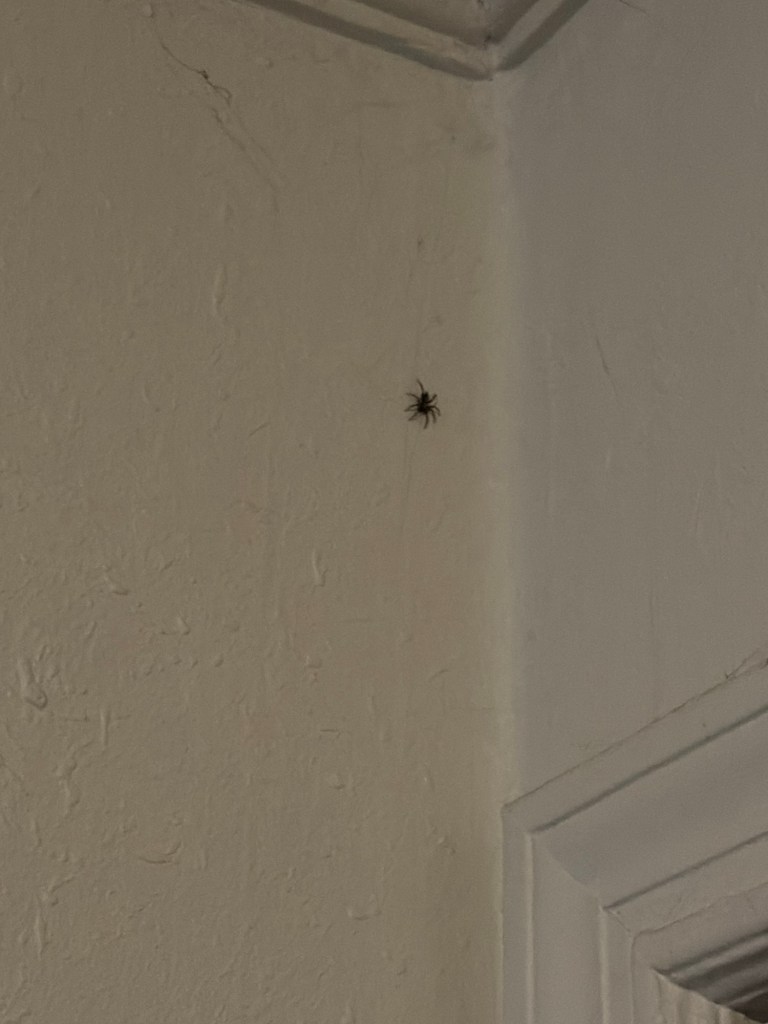
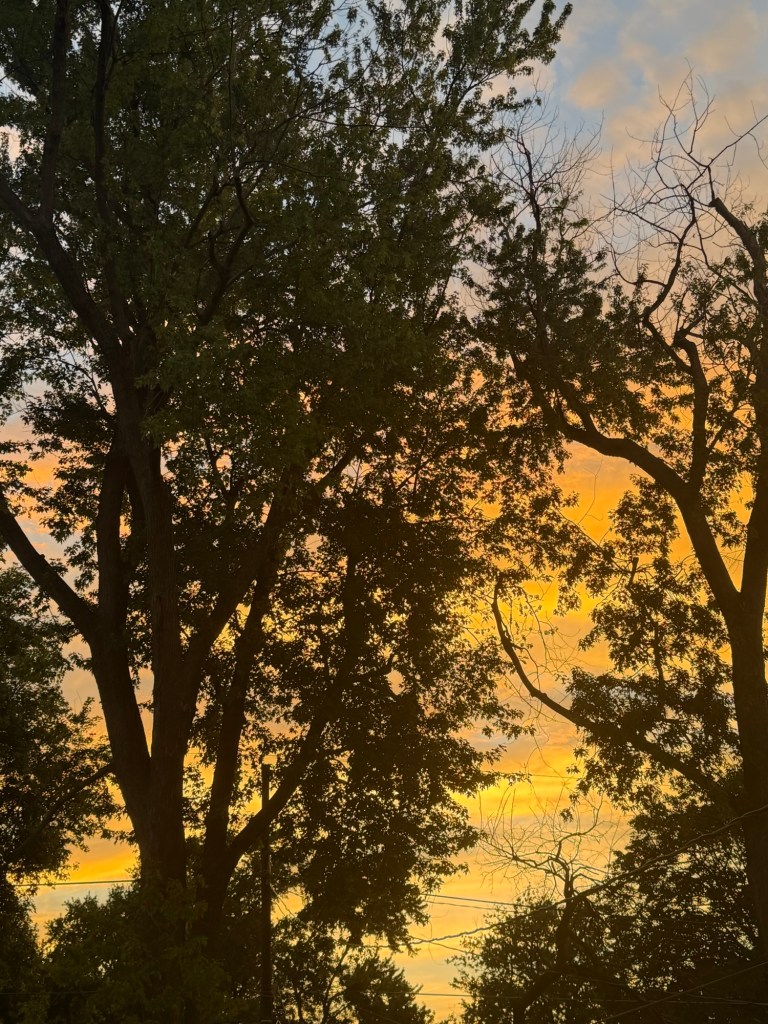
 destinylaharris